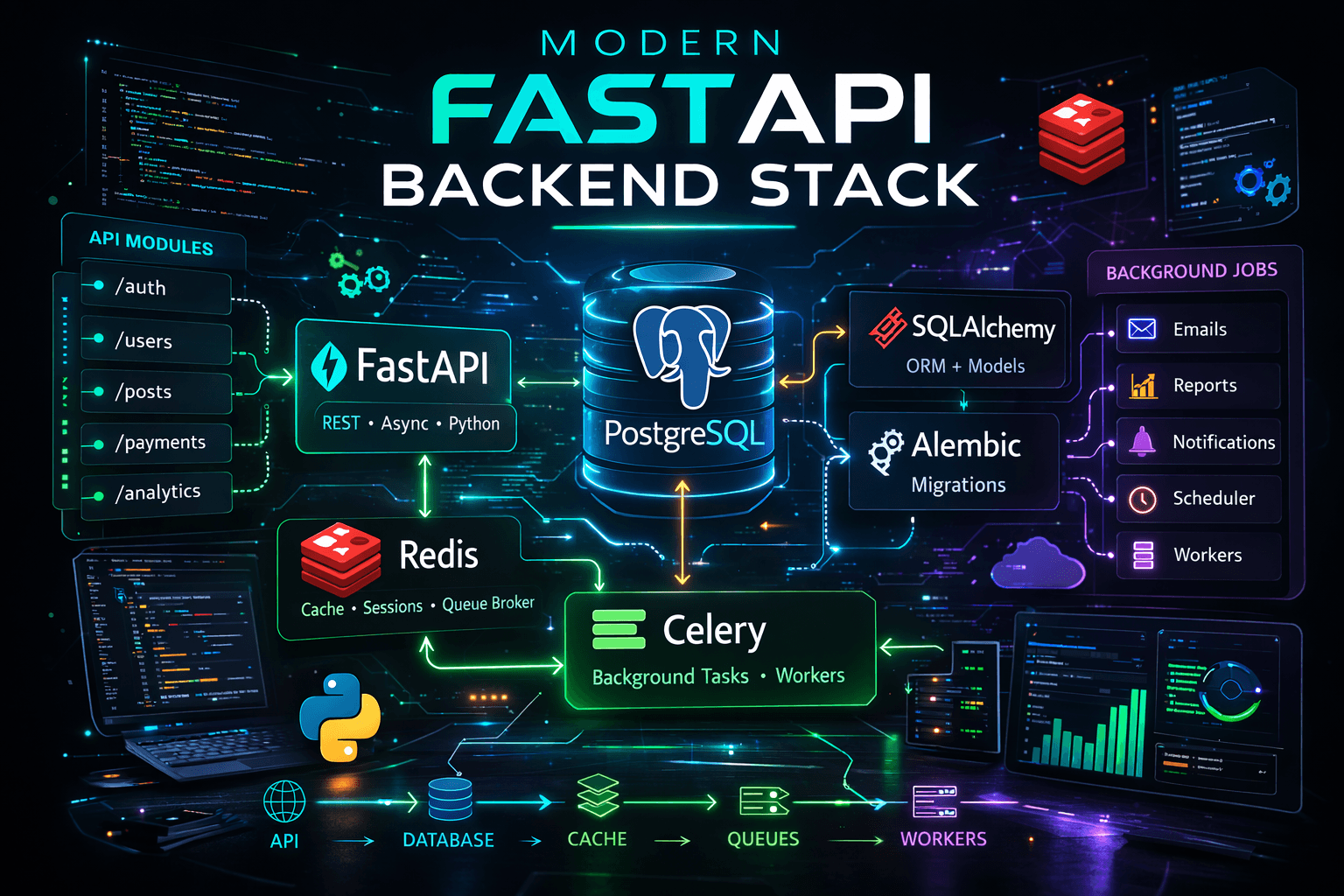
Modern FastAPI Backend Stack
A modern Python backend stack for teams that want speed, clean architecture, async APIs, reliable database workflows, background jobs, and scalable service foundations.
Descripción
FastAPI with PostgreSQL, SQLAlchemy, Alembic, Redis, and Celery forms a sharp and practical backend stack for modern applications. It is built for developers who want strong API performance, typed Python development, structured database access, reliable schema migrations, in-memory caching, and background job processing. This stack works especially well for SaaS products, internal platforms, dashboards, automation systems, and service-oriented backends that need clean foundations without dragging in unnecessary complexity. It is one of those stacks that feels modern without forgetting the old law of engineering: keep the core solid, or the whole house shakes.
Casos de uso
Use this stack when building REST APIs, admin platforms, internal business systems, task-processing services, multi-tenant SaaS platforms, analytics backends, authentication services, marketplaces, and automation-heavy applications. It is also a strong fit for systems that need async endpoints, background email sending, scheduled jobs, cache-backed performance, and transactional relational data. If your backend needs both speed and discipline, this stack earns its keep.
Arquitectura
A clean folder structure is one of the biggest advantages of this stack when building real-world backend systems. FastAPI works best when the codebase is split by responsibility instead of dumping everything into routes and models. A practical approach is to separate API endpoints, core configuration, database setup, domain models, schemas, services, background jobs, and shared utilities. This makes the project easier to maintain, scale, test, and onboard into as the application grows. Start with a modular monolith, keep domain boundaries clear, and avoid the classic mistake of turning the app into one giant main.py graveyard.
app/
├── api/
│   ├── v1/
│   │   ├── endpoints/
│   │   │   ├── auth.py
│   │   │   ├── users.py
│   │   │   ├── posts.py
│   │   │   └── health.py
│   │   └── router.py
│   └── deps.py
│
├── core/
│   ├── config.py
│   ├── security.py
│   ├── database.py
│   ├── redis.py
│   └── celery_app.py
│
├── models/
│   ├── user.py
│   ├── post.py
│   └── __init__.py
│
├── schemas/
│   ├── auth.py
│   ├── user.py
│   ├── post.py
│   └── common.py
│
├── services/
│   ├── auth_service.py
│   ├── user_service.py
│   ├── post_service.py
│   └── email_service.py
│
├── repositories/
│   ├── user_repository.py
│   └── post_repository.py
│
├── tasks/
│   ├── email_tasks.py
│   ├── report_tasks.py
│   └── cleanup_tasks.py
│
├── middleware/
│   ├── logging.py
│   └── rate_limit.py
│
├── utils/
│   ├── pagination.py
│   ├── exceptions.py
│   └── helpers.py
│
├── tests/
│   ├── api/
│   ├── services/
│   └── tasks/
│
├── main.py
└── __init__.py

alembic/
├── versions/
├── env.py
├── script.py.mako
└── README

docker/
├── api.Dockerfile
├── worker.Dockerfile
└── beat.Dockerfile

scripts/
├── start.sh
├── worker.sh
└── migrate.sh

.env
.env.example
requirements.txt
pyproject.toml
docker-compose.yml
README.md
Ventajas
FastAPI offers excellent developer experience, strong validation through Python typing, and high performance for API workloads. PostgreSQL brings mature relational power, strong indexing, and dependable transactional behavior. SQLAlchemy gives flexibility for modeling and querying complex business data. Alembic provides migration discipline, which saves teams from database chaos later. Redis adds speed where repeated reads or short-lived data would otherwise waste resources. Celery handles background work well and keeps request-response flows clean. Altogether, this stack is productive, scalable, and grounded in proven tools.
Desventajas
This stack is not the lightest setup for very small projects. SQLAlchemy can feel verbose or complex for beginners, especially when relationships and async patterns enter the room like uninvited cousins. Celery also adds operational overhead because queues, workers, retries, monitoring, and broker behavior all need proper handling. Redis is powerful, but teams can misuse it as a magical junk drawer if they do not define clear responsibilities. The stack is excellent, but it rewards engineering discipline rather than shortcuts.
Cuándo NO usarlo
Do not use this stack if you are building a tiny prototype with almost no background processing, no real caching needs, and very simple CRUD requirements. It may also be overkill for projects that can live comfortably on a serverless or ultra-minimal backend approach. If your team has little Python experience or does not want to manage worker infrastructure, Redis, and migrations, a simpler stack may move faster in the short term. Not every house needs six pillars.