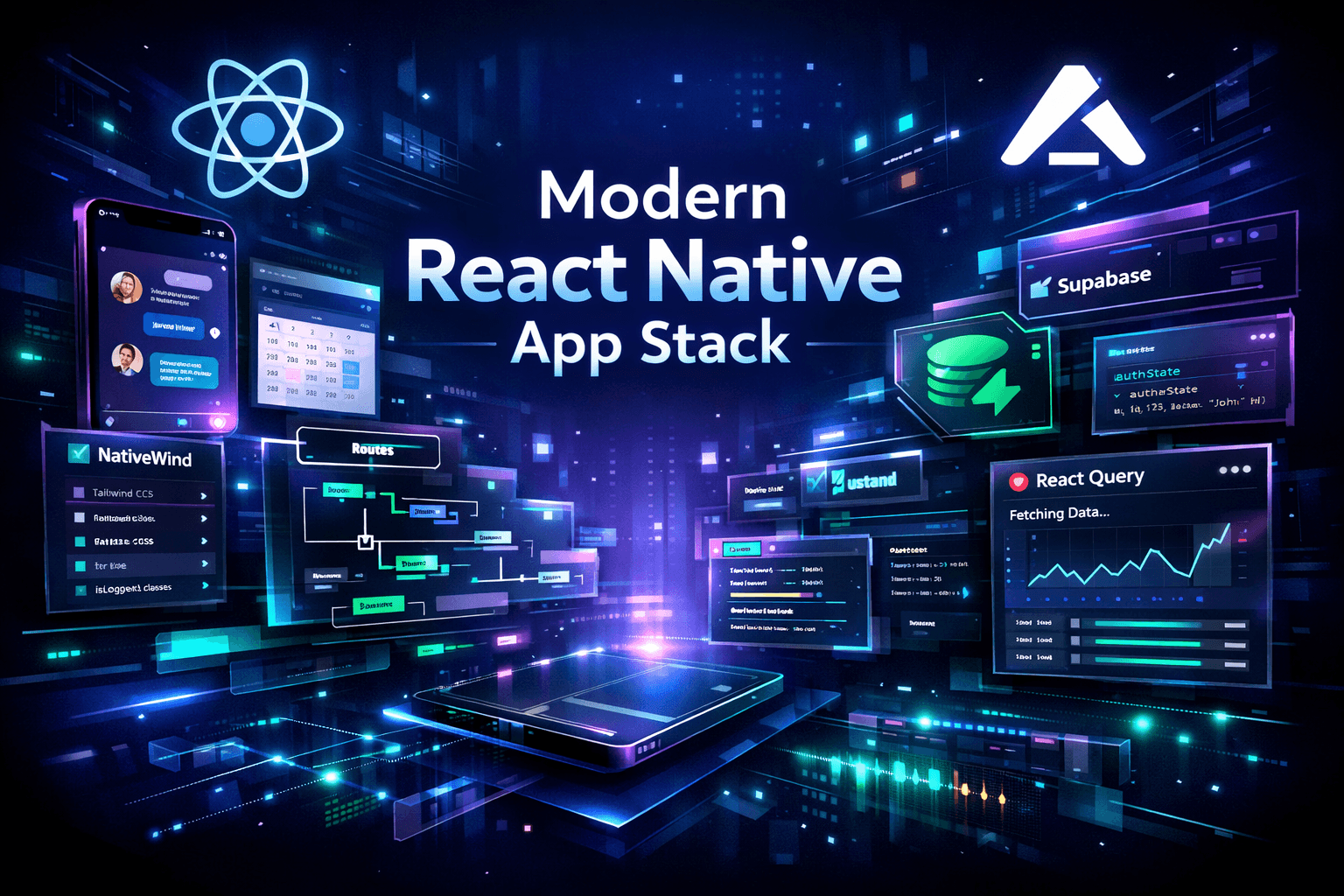
Modern React Native App Stack with Expo, Supabase, NativeWind, and Zustand
A practical mobile app stack built with Expo, React Native, Expo Router, Supabase, NativeWind, Zustand, and React Query for fast development, clean architecture, and scalable cross-platform apps.
Descripción
This stack is built for a modern cross-platform mobile application that moves fast without turning into chaos six months later. It combines Expo and React Native for the app runtime, Expo Router for file-based navigation, Supabase for backend services, Zustand for lightweight client state, and React Query for async server-state management.
It is a clean stack for teams that want developer speed, decent architecture, and room to grow without dragging around a mountain of boilerplate. Real talk: this is a sharp stack for startup-style products, internal apps, social apps, collaboration tools, and MVPs that may evolve into serious software.
Core idea of the stack:
- Frontend runtime: React Native + Expo
- Navigation: Expo Router + React Navigation
- Backend-as-a-service: Supabase
- Server state: TanStack React Query
- Client state: Zustand
- Styling: NativeWind + Tailwind Merge + CVA
- Animations: GSAP + gsap-rn + Reanimated
- Icons and visuals: Lucide React Native, Expo Image, Linear Gradient, Glass Effect
- Security and session storage: Expo Secure Store
- Language and typing: TypeScript
This stack has a good balance between modern DX and practical delivery. It avoids overengineering, but it does not feel like a toy.
Casos de uso
This stack fits especially well for:
- Social and collaborative apps
- Team communication tools
- Student or productivity apps
- MVPs that need mobile + web reach
- Apps with authentication, profiles, files, and real-time features
- Internal business apps with dashboards and workflows
- SaaS companion mobile apps
It is also a solid fit for apps that need:
- Fast onboarding
- Cross-platform delivery
- File uploads
- Auth flows
- Remote data caching
- Good UI velocity
- Scalable feature-based architecture
Arquitectura
A clean architecture for this stack usually looks like this:
App layer
Handles screens, routing, layouts, navigation, and platform entrypoints.
exporeact-nativeexpo-router@react-navigation/native@react-navigation/bottom-tabs
UI layer
Handles reusable design primitives, styled components, icons, visual polish, and animations.
nativewindclass-variance-authorityclsxtailwind-mergelucide-react-nativeexpo-imageexpo-linear-gradientexpo-glass-effectreact-native-svggsapgsap-rnreact-native-reanimated
State layer
Split state by responsibility instead of stuffing everything into one global store like it is 2018 and nobody learned anything.
- Server state:
@tanstack/react-query - Client UI/app state:
zustand
Backend layer
Supabase covers the heavy lifting for modern product teams.
@supabase/supabase-js
Typical responsibilities:
- Authentication
- Database
- Realtime
- Storage
- Row-level security
- API access through PostgREST
Device and platform layer
This is where Expo shines nicely.
expo-secure-storeexpo-document-pickerexpo-deviceexpo-web-browserexpo-linkingexpo-avexpo-splash-screenexpo-status-barexpo-system-ui
Ventajas
This stack has a lot going for it:
1. Fast development speed
Expo removes a ton of setup pain. You get moving quickly, and that matters. Shipping beats fantasizing.
2. Great cross-platform story
You can target Android, iOS, and web from one core codebase.
3. File-based routing
Expo Router makes navigation more intuitive and maintainable, especially in larger apps.
4. Good separation of concerns
React Query for remote data and Zustand for local state is a clean combo. Each tool does its job.
5. Modern styling workflow
NativeWind gives Tailwind-style productivity to React Native. Faster UI work, more consistency, less CSS drama.
6. Strong backend velocity
Supabase gives you auth, DB, storage, and realtime features without forcing you to build every wheel from stone.
7. Type safety
TypeScript helps keep the codebase sane as the app grows.
8. Smooth visuals
GSAP, Reanimated, gradients, image optimization, and glass effects make it easier to ship a premium-feeling UI.
Desventajas
No stack is magic. This one has trade-offs too.
1. Expo abstraction has limits
Expo is amazing until you hit edge-case native requirements. Then the fairy tale gets real.
2. Tailwind in React Native is not identical to the web
NativeWind is productive, but it is still React Native underneath. Some mental translation is required.
3. Supabase can become too central
If everything depends on Supabase from day one, future backend migration becomes harder.
4. Zustand can get messy without discipline
It is lightweight, which is great, but undisciplined stores can become a junk drawer very fast.
5. Animation complexity can explode
GSAP + Reanimated is powerful, but overusing motion can turn your app into a circus with dropped frames.
6. Web support is good, not magical
Expo web works, but don’t assume every mobile-first pattern feels perfect on desktop browsers.
Cuándo NO usarlo
This stack is not the right choice for every project.
Avoid it when:
- You need deep native platform customization from the start
- You require heavy low-level mobile SDK integration
- Your team already has a mature custom backend and strict domain architecture
- Your app must be offline-first with complex sync conflict resolution
- You need extremely custom rendering or game-like performance
- You want pure native Swift/Kotlin control with zero abstraction overhead
If your app is deeply native, highly regulated, or performance-critical in specialized ways, native-first architecture may serve you better.